3 Hardware
A computer has a central processing unit (CPU), memory and secondary storage.
3 (a) The computer has a Von Neumann architecture.
Circle three registers that are found in the Von Neumann architecture.
accumulator arithmetic register binary counter binary register control register current data register current instruction register data counter instruction counter logical register program counter storage register
3 (b) State the purpose of the CPU in the computer.
3 (c) Computer A has a 2.1 GHz quad-core processor. Computer B has a 2.5 GHz dual-core processor. Computer C has a 5.2 GHz single-core processor.
(i) Identify which computer is most likely to execute more instructions simultaneously.
Justify your answer.
3 (c)(ii) Explain why Computer C can execute more instructions per second than Computer B.
3 (d) All three computers have the same instruction set.
Define the term instruction set.
4 (b) The ATM is an embedded system.
Give two differences between a general-purpose computer and an embedded system.
4 (c) The ATM is adapted for use by visually impaired people.
Identify one input device and one output device that could be used by a visually impaired person to use the ATM.
5 (a) Complete the table with the missing terms and definitions about processing data.
| Term | Definition |
|---|---|
| current instruction register (CIR) | .................................................... |
| .................................................... | This is a processing unit within the CPU that can fetch, decode and execute instructions. |
| .................................................... | This is a list of all the commands that can be processed by the CPU. |
| cache | .................................................... |
| accumulator | .................................................... |
5 (b) Identify the component in the CPU that is responsible for decoding an instruction.
5 (c) Explain how the clock speed can affect the performance of a CPU.
A student's computer has primary storage. One example of primary storage is random access memory (RAM).
7 (a) Identify one other example of primary storage.
7 (b) Explain why RAM is an example of primary storage and not secondary storage.
7 (c) The student is editing a large video file and during this process the RAM becomes full. This makes the computer crash.
Describe how virtual memory could be used in this process to stop the computer crashing.
7 (d)(i) The computer uses solid-state (flash memory) storage.
Give two features of solid-state (flash memory) storage.
7 (d)(ii) Give two examples of solid-state (flash memory) storage.
An employee uses a computer that has a Von Neumann architecture to complete many different tasks in their working day.
(a) The computer has a central processing unit (CPU).
Complete the table of components in the CPU and their descriptions.
| Component | Description |
|---|---|
| It sends signals to all the components in the CPU to manage the flow of data through the CPU. | |
| It carries out all the arithmetic and logic operations in the CPU. | |
| cache | |
| program counter (PC) | |
| It controls the number of fetch–decode–execute (FDE) cycles that are performed per second. | |
| It stores data immediately before it is transmitted to RAM and immediately after it is received from RAM. |
[6]
Explain why the computer is not an embedded system.
[2]
2 A company employee is editing a video for the company's website. Data is stored in the random access memory (RAM) when the video is edited. The RAM becomes full and pages of data are transmitted to a partitioned section of the secondary storage to stop the computer from crashing.
(a) Give the name of the partitioned section of the secondary storage that is used in this process.
[1]
(b) The secondary storage is a hard disk drive (HDD). An HDD is an example of magnetic storage.
One feature of magnetic storage is that it uses platters.
Give three other features of magnetic storage.
1
2
3 [3]
(c) Give the reasons why an HDD is an example of secondary storage.
[2]
3 A computer with a Von Neumann architecture has several hardware components.
(a) Complete the table with the missing terms and descriptions about computer hardware.
| Term | Description |
|---|---|
| This is the address given to a network interface card (NIC) when it is manufactured. | |
| register | |
| clock | |
| control unit (CU) | |
| This is a processing unit within the CPU that can fetch, decode and execute instructions. |
(b) Identify three registers that are used in the fetch stage of the fetch-decode-execute (FDE) cycle.
1
2
3
[3]
(c) Circle the two buses that are used in the fetch stage of the FDE cycle.
binary control denary data information hardware software [2]
(g) The electronic calculator is an example of an embedded system.
Explain why it is an example of an embedded system.
(b) The device has 4 gibibytes (GiB) of random access memory (RAM).
(i) State the amount of RAM the device has in mebibytes (MiB).
(ii) State the amount of RAM the device has in tebibytes (TiB). Your answer can be given rounded to 3 decimal places.
(c) Explain why the portable device needs RAM.
(d) The device has a fingerprint scanner to allow the student to unlock the portable device.
Circle only three terms that can be used to describe the fingerprint scanner.
authentication biometric malware parity check
firewall input device output device storage device
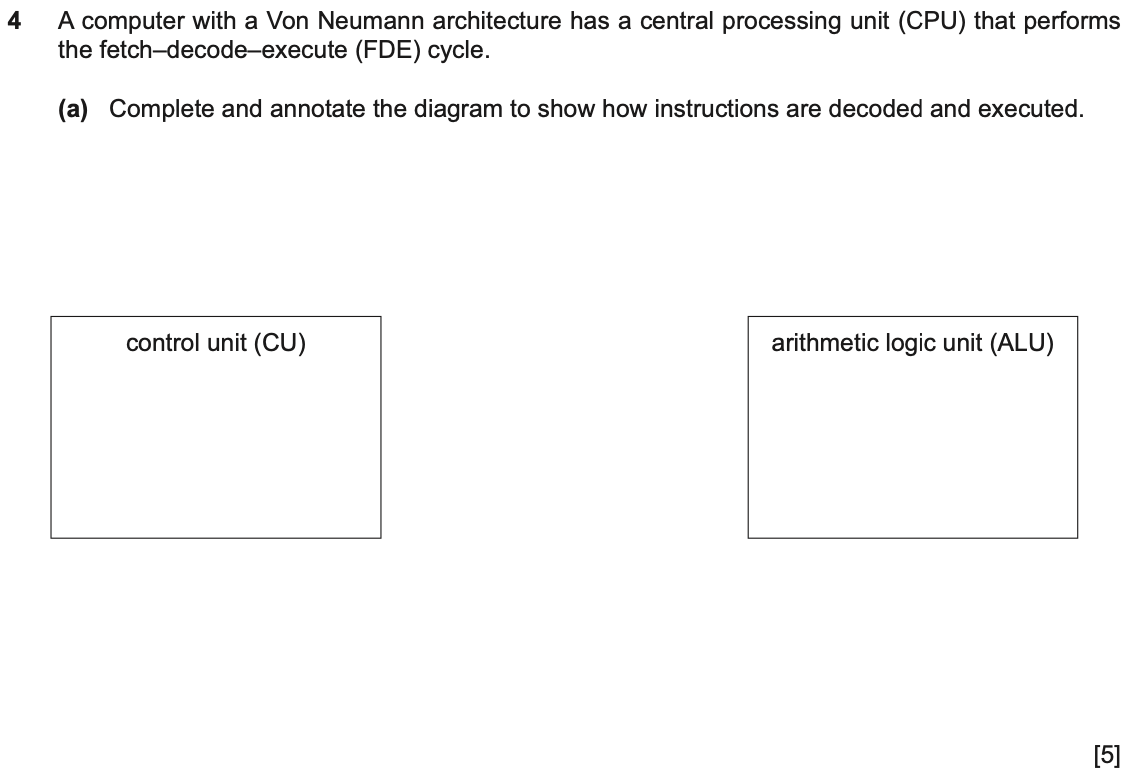
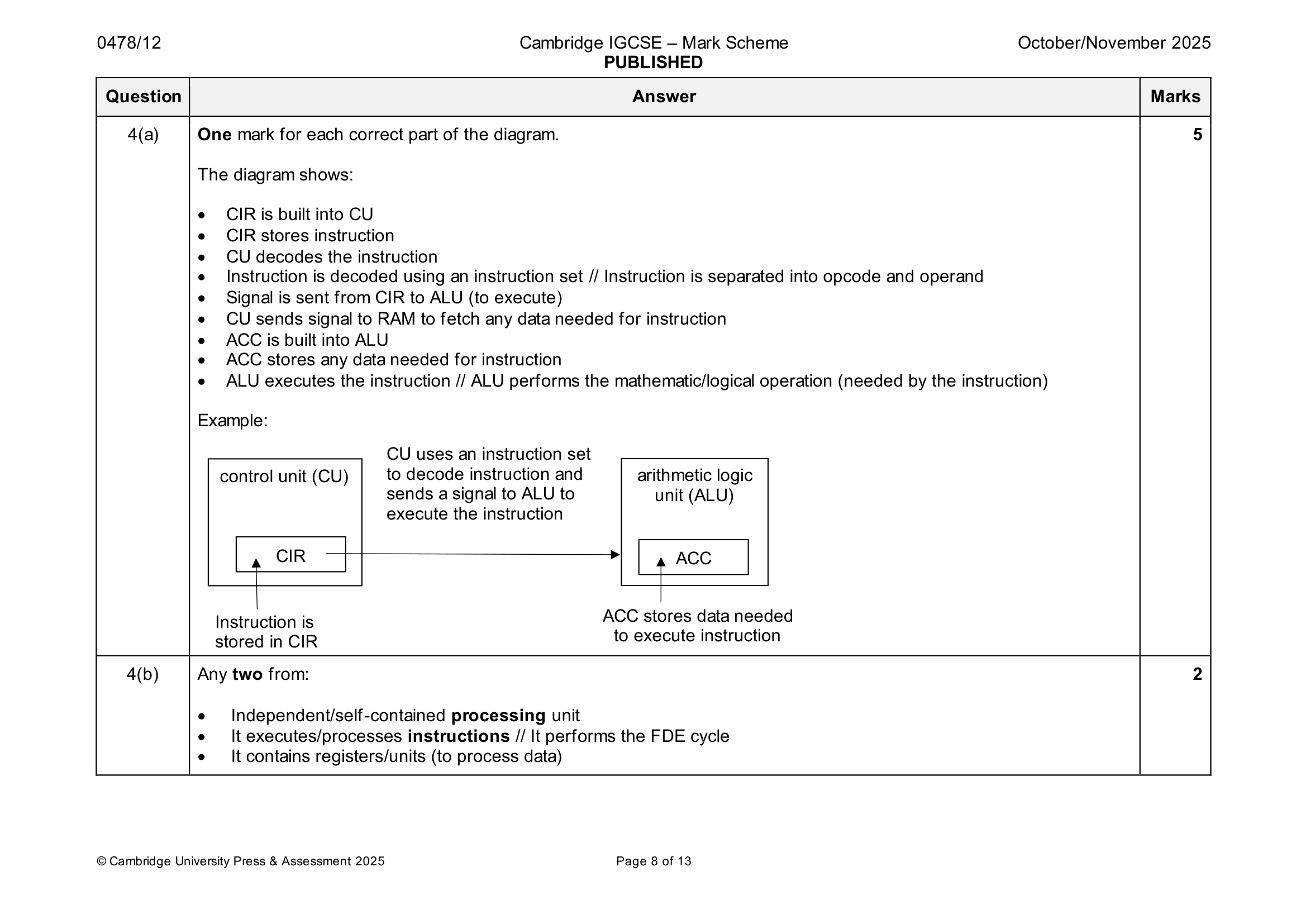
A computer with a Von Neumann architecture has a central processing unit (CPU).
(a) Complete the statements about the operation of the CPU.
Use the terms from the list. Not all terms will need to be used. You should only use each term once.
accumulator arithmetic logic unit character set
control unit current instruction register cipher decoding set
instruction counter instruction set memory address register
memory data register memory instruction register next instruction register
program counter program register
The ............................. stores the address of the next instruction to be fetched. This address is then sent to the ............................. . This address is the location in RAM where the instruction can be found. The instruction is retrieved from RAM and immediately stored in the ............................. . The instruction is then sent to the ............................. where it is decoded by the ............................. . The instruction is decoded using an ............................. .
(e) The hexadecimal code for each toy is stored in a barcode that is displayed on each toy.
Each time a customer buys a toy, the barcode is scanned and the amount of stock stored in the database for that toy is reduced by 1.
An item of hardware is used in this system to receive the hexadecimal code from the barcode scanner and find it in the database. The item of hardware is built into a single chip.
(i) Identify the name of the item of hardware.
(ii) Tick (✓) one box to show whether a barcode scanner is a type of input, output, process or storage device.
| A | input | ☐ |
| B | output | ☐ |
| C | process | ☐ |
| D | storage | ☐ |
(iii) The barcode scanner contains a sensor.
Identify the type of sensor that the barcode scanner could contain.
(iv) A backup of the database is made at the end of each day using optical storage.
Describe how the database is written to the optical storage.
(b) The CPU is dual core and has a processor speed of 2.4 GHz.
Describe what is meant by a core.
(c) Explain two ways that the performance of the CPU could be increased.
5 A computer system has a mouse.
An interrupt is sent to the CPU every time a button on the mouse is clicked.
(a) Identify the name of this type of interrupt.
(b) The interrupt is placed in a queue.
Explain how the interrupt is serviced after it is placed in the queue.
(b) Identify the input device that allows voice commands to be used as input.
(d) The smart speaker is an example of an embedded system.
Explain why the smart speaker is an embedded system.
A flower shop has a room that has an air-conditioning system. It is used to keep the room at a constant temperature for storing flowers.
The owner uses a keypad to set the temperature for the room.
(a) Tick (✓) one box to show whether a keypad is an example of an input, output, process or storage device.
A input
B output
C process
D storage
[1]
(e) The air-conditioning system uses a temperature sensor and a microprocessor to keep the temperature of the room at a constant level.
(i) Tick (✓) one box to show whether the sensor is an example of an input, output, process or storage device.
A input
B output
C process
D storage
[1]
(ii) The temperature sensor continuously sends analogue data to the microprocessor. This data is then converted to digital.
Explain how the microprocessor keeps the temperature of the room at a constant level.
...................................................................................................................................................................................................................
...................................................................................................................................................................................................................
...................................................................................................................................................................................................................
...................................................................................................................................................................................................................
...................................................................................................................................................................................................................
................................................................................................................................................................................................. [3]
(f) The air-conditioning system is an example of an embedded system.
Explain why the air-conditioning system is an embedded system.
...................................................................................................................................................................................................................
...................................................................................................................................................................................................................
...................................................................................................................................................................................................................
......................................................................................................................................................................................... [2]
A computer with a Von Neumann architecture has a central processing unit (CPU) that carries out the fetch-decode-execute (FDE) cycle.
(a) Give the name of the first register that is used in the fetch part of the cycle.
......................................................................................................................................................................................... [1]
(b) The CPU has a control unit (CU).
(i) Describe the role of the CU in the CPU.
...................................................................................................................................................................................................................
...................................................................................................................................................................................................................
...................................................................................................................................................................................................................
...................................................................................................................................................................................................................
...................................................................................................................................................................................................................
................................................................................................................................................................................................. [3]
(ii) Give the name of the register that is part of the CU.
................................................................................................................................................................................................. [1]
(c) The computer has primary storage. One example of primary storage is cache.
(i) Tick (✓) one box to show the correct statement that describes the purpose of cache.
A It stores important instructions.
B It stores the next instruction to be processed.
C It stores frequently used instructions.
D It stores instructions so they are not lost when the power is turned off.
[1]
(ii) Give one other example of primary storage.
Identify the type of data your example would store.
Primary storage .....................................................................................................................................................................................................
Data ...................................................................................................................................................................................................................
...................................................................................................................................................................................................................
[2]
(d) The computer also has secondary storage.
Write the name of the type of secondary storage for each description in the table. Each type of secondary storage may be used more than once.
Type of secondary storage - Description
............................................................................................. - It burns pits and lands onto a disk.
............................................................................................. - It uses control gates and flow gates.
............................................................................................. - It uses NAND or NOR technology.
............................................................................................. - The surface of each platter is divided into tracks and sectors.
............................................................................................. - It has a read/write arm that moves a laser across a disc.
............................................................................................. - It controls the flow of electrons using transistors.
[6]